Three Names, One Slam: Designing Ground Slam
Published 1 September 2026Not every Sorcery card starts with a flash of inspiration or follows a straightforward path to the finished card you eventually hold in your hand.
Before it was Ground Slam, it was Tectonic Slam. Before that, Seismic Slam. And across those different names were several different versions of the card as we worked out exactly what a Fire-and-Earth spell should feel like.
Finding Fire and Earth
The starting point for Ground Slam was a fairly simple design challenge. All we had to do was create a spell that felt distinctly like Fire and Earth magic. We knew this would be an important part of bringing the fantasy of the Lavamancer to life in our upcoming Frost Mage vs. Lavamancer decks, so the pressure was on to get it right.
As we started exploring what that could look like, Game Designer Sean Goodison kept coming back to a familiar action-RPG trope.
“We were inspired by that trope in action role-playing games, where you have this big hit where things go flying, or you create a fissure in front of you.”
Combining two elements, though, means doing more than putting an Earth effect and a Fire effect on the same card. The mechanics need to feel like they belong together.
Some of the earliest versions approached the problem from the mechanics first. One early concept dealt damage to every unit at a nearby land site, then prevented units from entering that site until the following turn.
We could see the ingredients, but as Game Designer Rafa Novellino remembers, it wasn’t quite landing.
“Damage suggested Fire and altering the battlefield suggested Earth, but there was a lot to remember, and the effect didn’t really tell a compelling story.”
So, what does Fire and Earth actually look like when it becomes one spell?
Searching for the Fantasy
Another version pushed the damage considerably further: “Deal 5 damage to target minion at a site up to two steps away. Any number of times, you may target another minion there with any leftover damage.”
This introduced the idea of damage spilling from one target into another, something we hadn’t really explored in Sorcery before. It was interesting, but it still felt too much like Fire. There wasn’t enough Earth.
Somewhere along the way, the conversation got much simpler: what if someone just hit the ground really, really hard?
From there, we started discussing versions in which an ally struck its own site, and the force of that impact hurt everything around it.
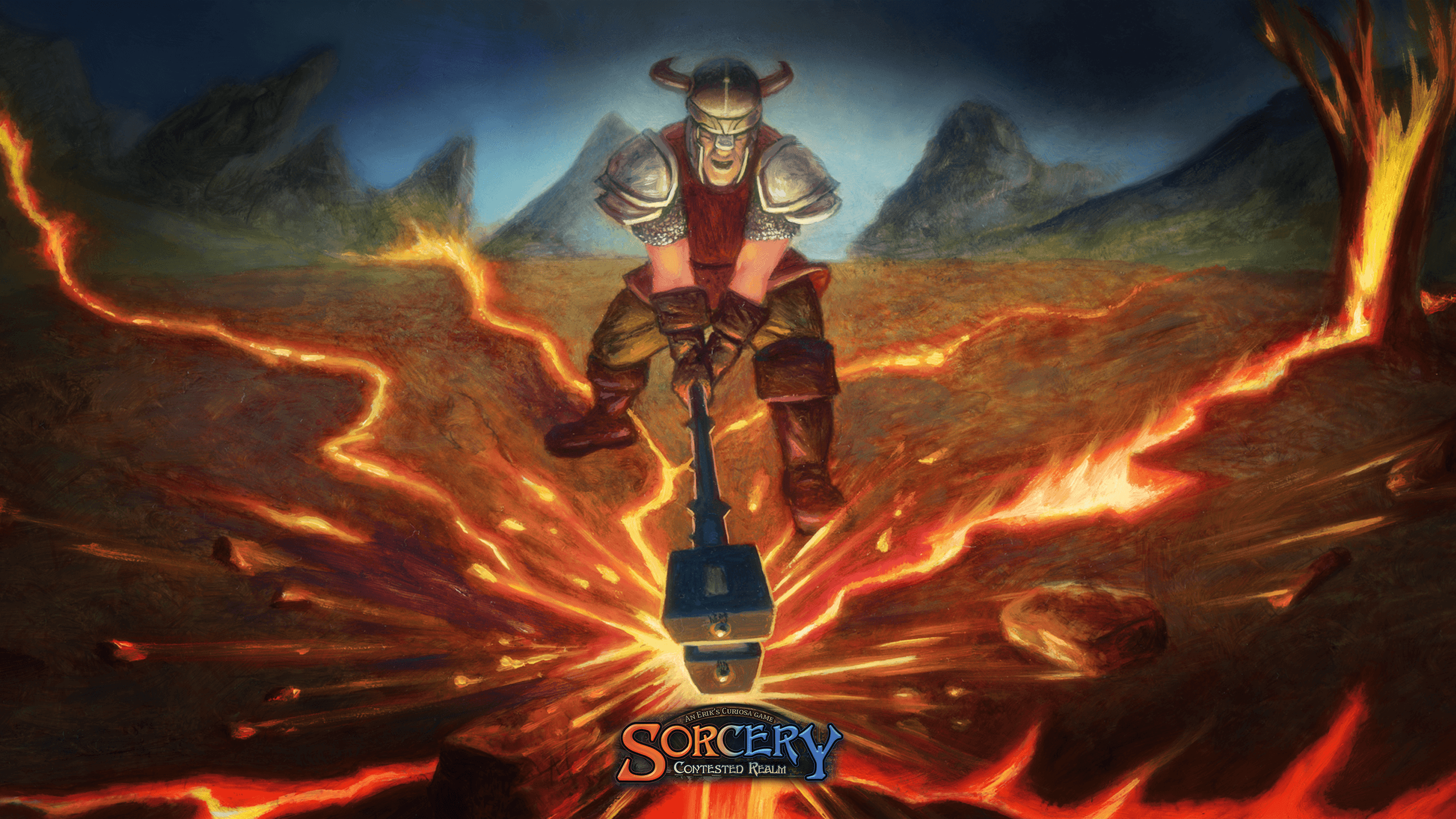
Now we had something we could picture: a massive warrior bringing their weapon crashing into the earth, the ground buckling beneath the impact, and fiery fissures erupting outward. Anything nearby gets caught in the blast.
Hitting the Sweet Spot
Finding the fantasy didn’t mean the card was finished. At one point, the effect had the ally strike its site and every other nearby unit.
As Game Designer Kevin Chen remembers, that version went a little too far.
“Ground Slam needed to feel strong. It’s one of the signature spells on the Lavamancer side of Frost Mage vs. Lavamancer, and we wanted it to sit comfortably alongside the Frost Mage’s own iconic spells, like Frost Bolt. But there needed to be a difference between powerful and… everything nearby just got flattened.”
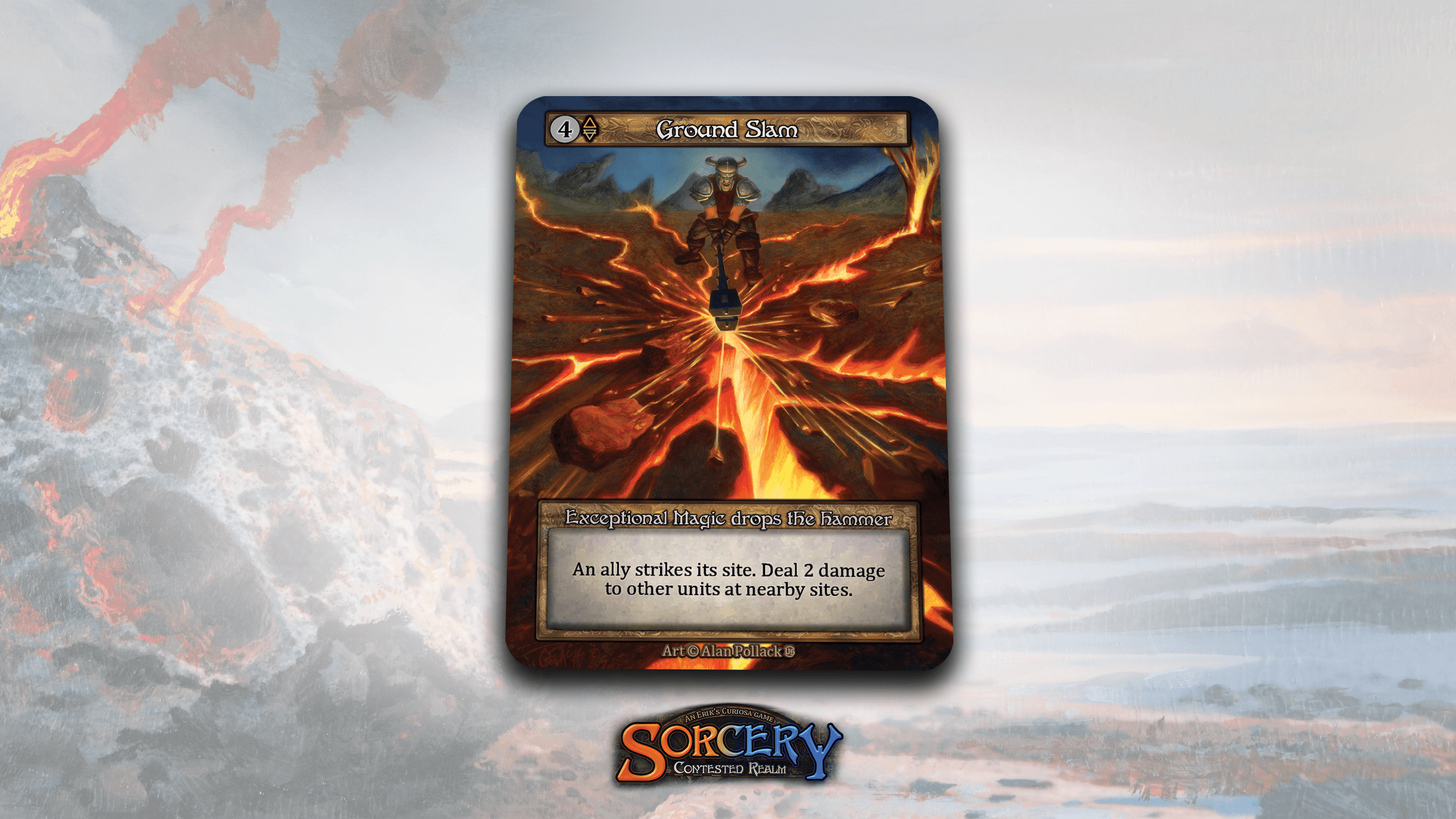
The final design pulled things back without losing what we liked about the idea. Ground Slam still deals damage across an area, but now the ally also strikes the site beneath it.
Earth decks also tend to have access to big, chunky minions, making that strike considerably more threatening when Ground Slam is used alongside the kinds of allies it was designed to complement.
Bringing the Slam to Life
Once the mechanics were in place, we had a much stronger picture of what the spell should look like. It had to be a warrior driving their weapon into the ground, the earth cracking beneath them, with bright, fiery fissures spreading outward from the point of impact.
That brought Alan Pollack to mind. Alan has a knack for bright, energetic fire, something Sorcery players may recognize in pieces like Flaming Sword, and that made him a natural fit for Ground Slam.
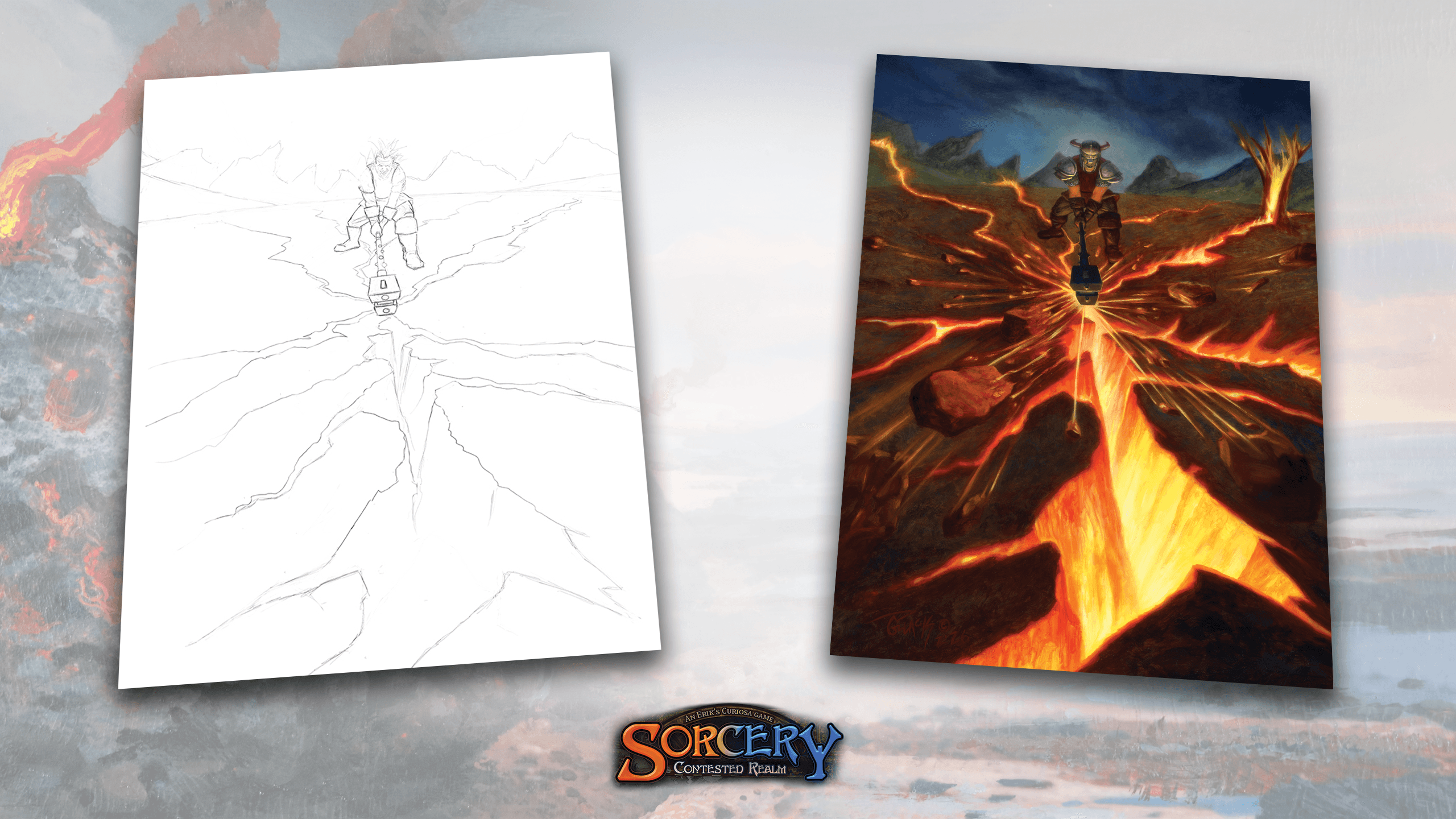
The art direction emphasized the impact rather than simply the warrior, pulling the viewpoint back enough to see the ground breaking apart and the fissures radiating outward.
“There wasn’t much difference really between the sketch and final piece,” Alan recalls. “The team gave me the prompt, and I created the sketch.”
Sometimes our finished artwork causes us to reconsider an aspect of a card as everything comes together. Ground Slam certainly wasn’t one of those cases, and we can all agree that Alan nailed it!
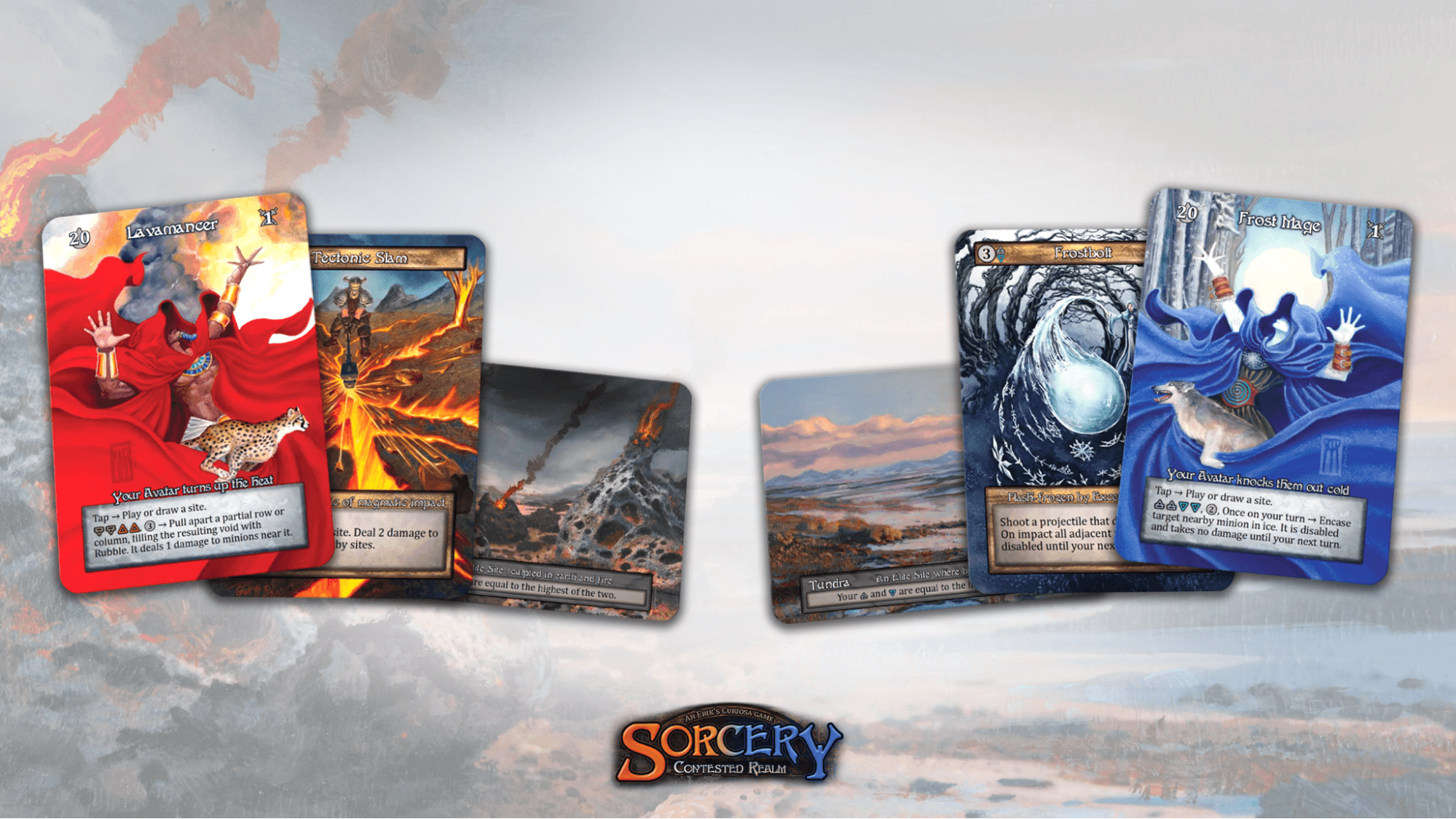
(Early concept layout featuring the “Tectonic Slam” name)
Seismic, Tectonic, Ground Slam
With the design and art in place, there was still the matter of the name.
When Alan first completed the piece, it was titled Seismic Slam. Later in development, it became Tectonic Slam.
There were advocates for the name Tectonic Slam on the team. It felt elemental and helped emphasize the Lavamancer’s connection to Earth. It also stuck around long enough to appear in some preliminary materials created while Frost Mage vs. Lavamancer was still in development.
As the product moved toward completion, Erik pushed for a name that was simpler and more immediate. Kevin recalls that the goal was to capture something essential and archetypal. The kind of ability, like Fireball, that would feel immediately at home in a classic RPG of the ’80s or ’90s. You shouldn’t need to think very hard about what happens when you cast this spell: you slam the ground. And so, after several iterations, Ground Slam had its name.
From Seismic Slam to Tectonic Slam to Ground Slam, the card changed quite a bit along the way. Sometimes a card arrives almost fully formed; other times, we have to keep chipping away at it until the mechanics, art, and name all feel like they belong to the same idea.